March 16, 2026
The End of Linear Work
How AI swarms are breaking the most fundamental constraint of human productivity. On orchestration thinking, parallel execution, and why tiny teams will outperform companies 50x their size.
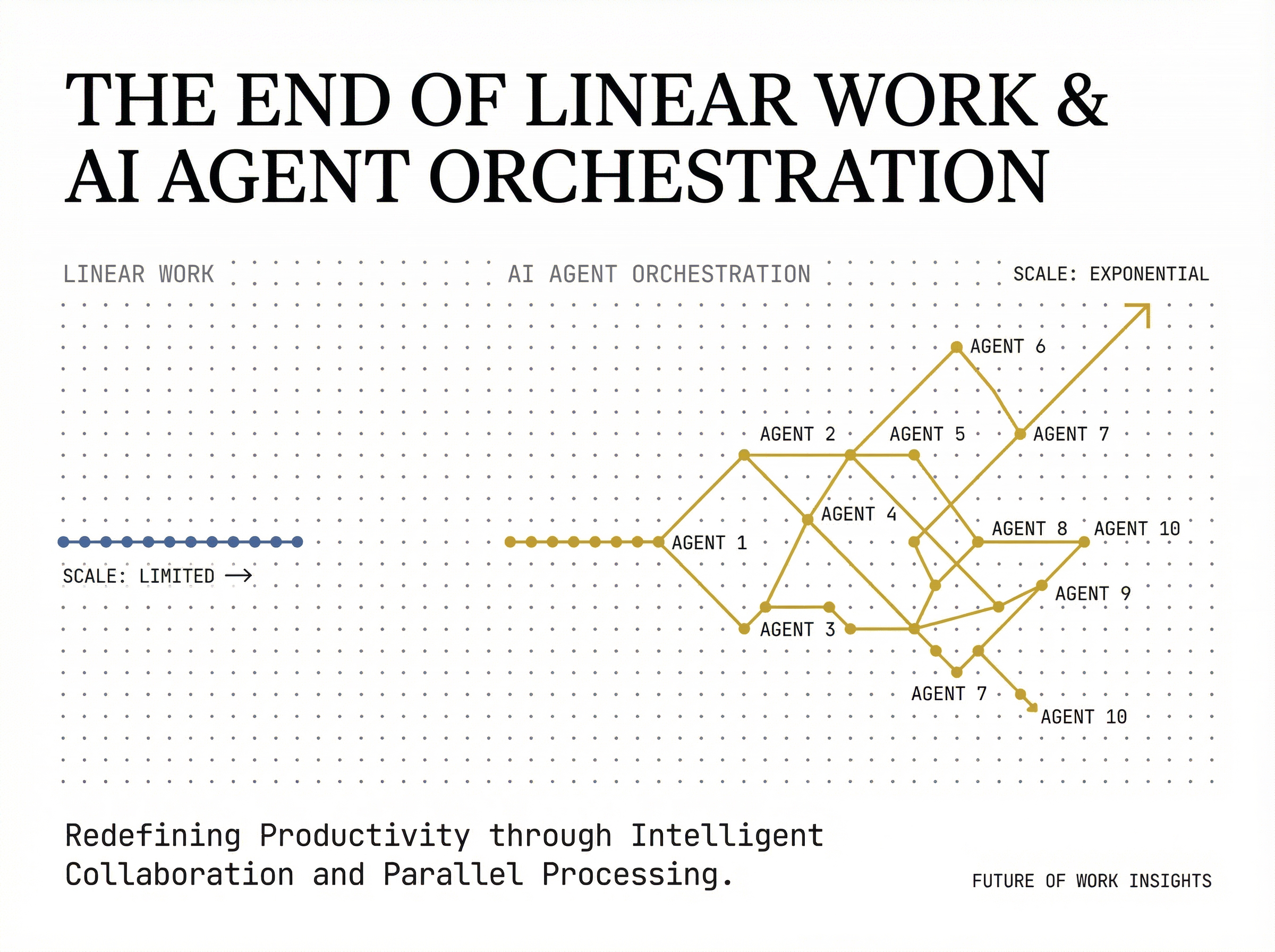
There’s a lie we’ve all internalized so deeply we forgot it was a lie.
The lie is this: work is sequential.
Step 1, then step 2, then step 3. Write the strategy, then the content, then the designs, then the website, then the SEO. One thing at a time. One brain at a time. One clock ticking for everyone.
I believed this for 15 years. I built companies around it. Hired teams to work within it. Optimized inside the constraint — better processes, tighter timelines, smarter prioritization.
Then, lately, I broke out of it entirely.
I’m not going back.
The night everything changed
Late January 2026. A few days after setting up my OpenClaw. I had a client deliverable that should have taken a team of five about a month. Content strategy, brand guidelines, social media frameworks, editorial calendars, website architecture, SEO plans, AI integration roadmaps — the full stack of a digital transformation.
Instead of building a Gantt chart, I did something different.
I sat down at 10 PM. Wrote one master brief — a strategic document that captured the vision, the brand DNA, the constraints, the objectives. Then I spawned 35 AI agents. In parallel. Simultaneously.
Not 35 copies of the same task. 35 different tasks, all running at once. One writing brand voice guidelines. Another building an editorial calendar. Another architecting the website. Another running competitive SEO analysis. Another generating social media content frameworks. All working from the same strategic brief, all producing output at the same time.
By 2 AM, I had 70+ deliverables. Not drafts. Not outlines. Finished, client-ready documents.
Four hours. One human. A month of linear work.
That night I didn’t just save time. I experienced a fundamentally different kind of work. Once you experience it, you can’t unsee it.
Four levels of the swarm
Non-linear AI work isn’t one thing. It’s a ladder. Most people haven’t found the first rung.
Level 1: One agent, multiple tasks
This is where most “AI power users” are today, if they’re lucky.
You have one agent — Claude, GPT, whatever — and you ask it to break a task into subtasks, then execute each one. It does thing A, then thing B, then thing C. Faster than doing it yourself. But still linear. One brain, one thread, one task at a time.
Like having one very fast employee. Brilliant, doesn’t sleep, doesn’t complain. But still one person working through a to-do list top to bottom.
This is where 99% of AI usage stops. It’s barely scratching the surface.
Level 2: One human, multiple agents
This is the first real unlock. You stop talking to one agent and start working with several in parallel.
Different AI tools for different jobs — one writing copy, another generating images, another analyzing data, another coding. You’re the conductor, switching between them, feeding outputs from one into another, keeping the threads in your head.
It’s messy. It’s manual. But it’s the first time you feel the sequential bottleneck crack. You’re not 10x faster — you’re doing multiple things at once. The parallelism is real, even if the coordination is all you.
Most people who call themselves “AI power users” are somewhere between Level 1 and Level 2.
Level 3: One human, one orchestrator, multiple agents
This is where things break open.
Instead of manually juggling multiple agents yourself, you talk to an orchestrator. A master agent whose job isn’t to do the work but to deploy and coordinate other agents who do the work. You give the orchestrator a strategic brief. It breaks it into parallel workstreams. Spawns 10, 20, 35 agents — each with a specific mission, specific context, specific output format. All working simultaneously.
The orchestrator manages dependencies, collects outputs, ensures consistency.
You? You’re the strategist. You set the vision. Review the output. Make the calls that require human judgment, taste, and context.
This isn’t “delegating to AI.” This is commanding a swarm.
The difference is profound. Level 2 makes you faster. Level 3 puts you in a different dimension. You’re not doing work faster — you’re doing work that couldn’t exist in a linear paradigm. A solo entrepreneur delivering what used to require an agency of 15 people. Not over months. Over hours.
I’ve done this repeatedly. 35+ parallel agents on brand deliverables. 800+ SEO-optimized product descriptions in a single session. Complete content ecosystems — strategy, voice, calendar, copy, visual direction — in one sitting.
Not because I’m special. Because the paradigm is different.
Level 4: One human, multiple orchestrators
This is where I am now.
Instead of one orchestrator managing a swarm, you have multiple orchestrators, each managing their own swarm, each handling a different domain.
One orchestrator runs your content engine — spawning agents for writing, SEO, social, email. Another manages product development — code, design, testing, deployment. A third handles research — competitors, markets, synthesis.
You sit above all of them. You’re not managing tasks. Not even managing agents. You’re managing orchestrators. Your job is pure strategy: vision, direction, taste. The execution layer is an entire organization that runs around the clock and scales up or down in seconds.
This isn’t science fiction. The infrastructure exists today. I know because I’m running it — every day, across multiple domains of my business.
This isn’t about productivity
When I talk about swarms and orchestrators, most people hear “productivity hack.” They think I’m talking about doing the same work faster.
I’m not.
I’m talking about what becomes possible for a single human being.
Think about what held entrepreneurs back for 50 years. It wasn’t ideas — ideas are cheap. It wasn’t capital — capital finds good ideas eventually. It was execution bandwidth. How many things can you actually do with the hours and hands you have?
That bottleneck just evaporated.
A solo founder with swarm orchestration can execute at the level of a 30-person agency. Not “kind of.” Actually. The outputs are real. The clients are real. The revenue is real.
This changes the math on everything:
- Who can start a company — anyone with vision and orchestration skill
- What size team you need — maybe just you and your swarm
- How fast you can iterate — daily cycles instead of quarterly
- What counts as competitive advantage — not headcount, orchestration depth
The new skill: orchestration thinking
Nobody’s teaching this yet. Almost nobody knows it exists.
The skill that matters in the swarm era isn’t prompting. It’s not “AI literacy.” It’s not knowing which model to use for what.
It’s orchestration thinking. The ability to decompose complex work into parallel streams. Write strategic briefs that give agents enough context to operate autonomously. Manage quality across dozens of simultaneous outputs. Synthesize the results into something coherent.
This is a new cognitive skill. It doesn’t map onto anything from the pre-AI world. Part project management, part systems thinking, part creative direction. You’re a general deploying units across a battlefield, except the battlefield is your business and the units spin up in seconds.
The people who are best at this aren’t necessarily the most technical. They’re the ones who can hold a complex vision in their head and decompose it into clear, autonomous work packages. They think in systems, not steps. They design for parallelism, not sequence.
There aren’t many of them. Not yet.
The uncomfortable implication
I started this piece talking about a lie — that work is sequential.
Here’s what follows: most of what we call “organizations” are expensive workarounds for the sequential bottleneck.
Why do you need a team of 15? Because one person can’t do 15 things at once. Why do you need managers? Because someone has to coordinate the sequential handoffs. Why do you need 3-month project timelines? Because work moves at the speed of the slowest human in the chain.
What happens when the sequential bottleneck disappears?
I don’t have the full answer. Nobody does. We’re the red dot on that chart — the 0.04% building with agent infrastructure. But I have a directional sense:
The future belongs to tiny teams with massive swarms.
Two, three, five people — each one an orchestrator, each commanding their own constellation of agents. These micro-teams will outperform companies 50x their size. Not because they work harder. Because they work in a fundamentally different dimension.
Linear vs. non-linear isn’t an incremental improvement. It’s a phase transition. Horse to car. You don’t optimize the horse. You change the paradigm.
Where we are right now
I’m writing this in March 2026. It’s 3 AM in Brazil. My orchestrator has been running background tasks while I wrote this — monitoring, organizing, preparing tomorrow’s workflow.
A few months ago, I ran my first real swarm and it felt like discovering fire. Weeks later, I started thinking in orchestrators instead of agents. Now I’m at Level 4, where my orchestrators each run their own domain.
Each level feels like stepping into a bigger world. Each one makes the previous look quaint.
If you’re still working linearly — even using AI, but one task at a time — you’re driving a Ferrari in first gear. The engine is there. The power is there. You just haven’t shifted yet.
The shift isn’t technical. It’s mental. Letting go of the lie that work must happen one thing at a time. Accepting that you can be in 35 places at once if you architect it right.
The swarm is getting smarter, faster, and more autonomous every month. The question isn’t whether this transforms how humans work. It already has.
The question is which side of that transformation you’re on.