March 16, 2026
Outside the Bubble
2,500 dots. 84% grey. We're not early — we're in a different universe. On the exponential gap between AI builders and everyone else.
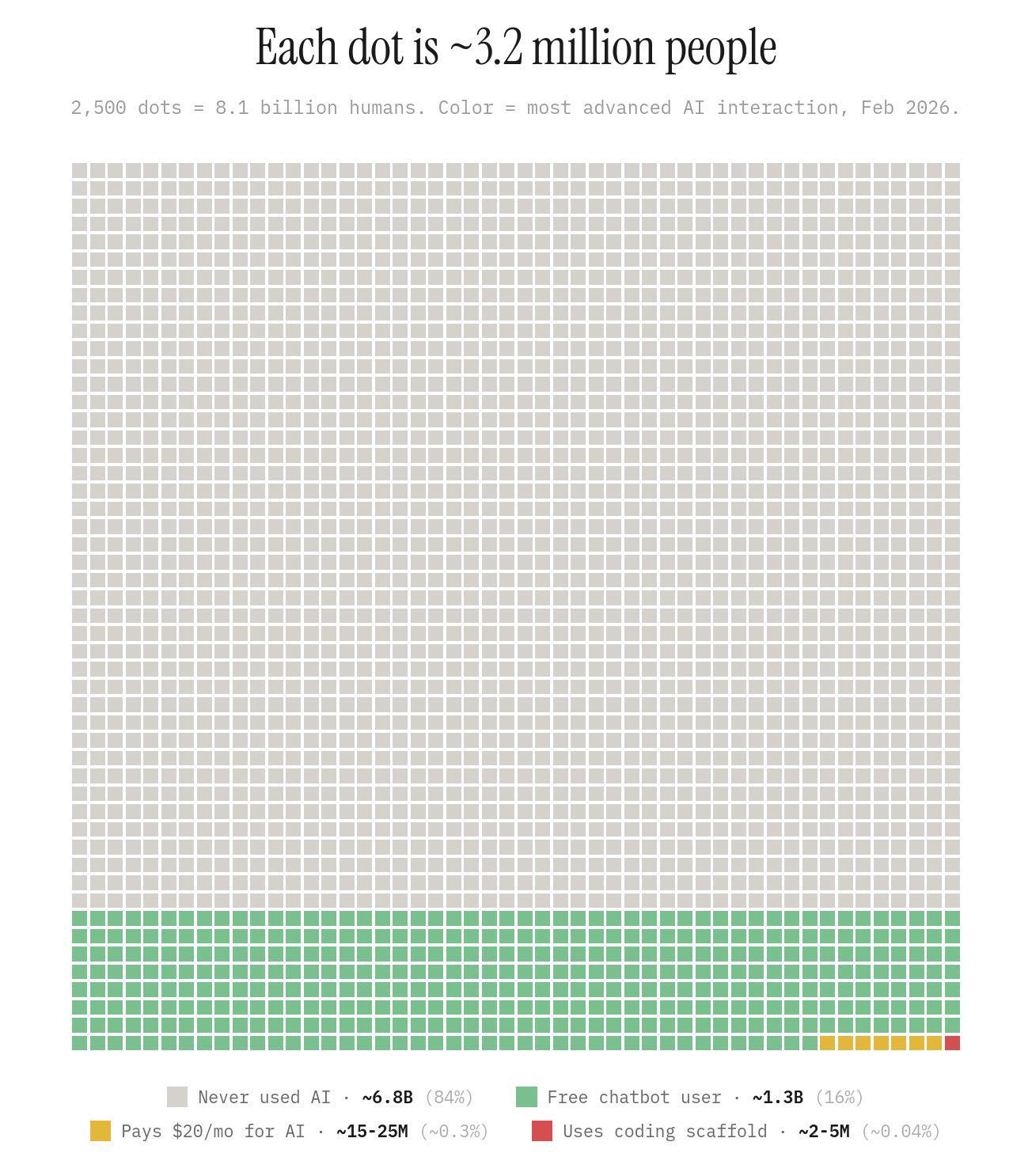
Look at that image for a second. Don’t skim it.
2,500 dots. Each one is 3.2 million people. The grey is everyone who’s never touched AI. The green strip at the bottom? Free chatbot users. The tiny yellow sliver? People who pay $20/month. The single red dot? People who actually build with AI.
You’re reading this on a device that puts you in the 16%. Probably the 0.3%. If you’re orchestrating AI agents, you’re the red dot. One of maybe 5 million humans on a planet of 8 billion.
Let that sit.
Every tech wave creates a bubble
The people inside think everyone sees what they see. They never do.
I’ve lived through enough of these to know the pattern. But this time the gap between inside and outside isn’t just wide. It’s widening at a rate that has no historical precedent.
Let me show you what I mean.
The speed of the gap
Dotcom Boom (1995-2000) The gap: “The internet will change commerce” vs “Why would I buy something I can’t touch?” Seven years to reach 50% of US households. You could build a website in 2003 and still be early. Gap speed: walking.
Smartphones (2007-2015) The gap: “This replaces your computer, camera, GPS, and wallet” vs “I just need a phone that calls.” Eight years to 50% global penetration. Instagram launched three years after the iPhone and still won. Gap speed: jogging.
Social Media (2004-2012) The gap: “User-generated content will kill media gatekeepers” vs “Why would anyone read a blog?” Six years for Facebook to hit a billion users. Started a YouTube channel in 2010? Still early. Gap speed: running.
AI (2022-Now) The gap: “I have AI agents running my business” vs “I tried ChatGPT once, it made stuff up.” ChatGPT hit 100 million users in two months. But deep usage? 0.3% pay. 0.04% build. The catch-up window shrinks by the week. Every month you wait, you’re not one month behind. You’re six months behind. Gap speed: escape velocity.
Why this gap is different
I’ve been building with AI since early 2023. Three years in, I can tell you — this isn’t like the other waves. Not because everyone says “this time is different.” Because the mechanics are structurally unlike anything before.
The tool improves itself. The internet didn’t get better at being the internet because you used it. Your smartphone didn’t learn from how you swiped. AI compounds. The people inside the bubble aren’t just using a better tool. They’re using a tool that gets better because they use it. That feedback loop didn’t exist in any previous revolution.
The skill gap is invisible. During the dotcom boom, you could see who was online and who wasn’t. With mobile, you could see who had a smartphone. AI is different. Two people sit next to each other in an office. One writes a report in 20 minutes with Claude. The other spends three days on it. From the outside, both “wrote a report.” Nobody sees the gap. Which means nobody checks it. Which means it grows unchecked.
The adoption curve is a cliff, not a slope. Previous waves had gradual adoption. Grandma eventually got on Facebook. Your uncle eventually got a smartphone. AI has a skill cliff. Free chatbot usage is easy — 1.3 billion people are already there. But the jump from “I ask ChatGPT questions” to “I orchestrate AI agents running parallel workflows” isn’t a gentle slope. It’s a vertical wall. The 0.3% isn’t growing linearly. It’s a different species of user.
The compound knowledge effect. Someone who started using AI seriously in January 2023 has three years of compounded intuition. They’ve built prompt instincts, workflow patterns, mental models for what works and what doesn’t. That knowledge compounds like interest. A newcomer in March 2026 isn’t “three years behind.” They’re missing three years of compound learning in a field where the tool itself changed 10x during that period. You can’t skip the reps.
The uncomfortable truth
The dotcom bubble popped. Smartphones became universal. Social media matured. Those gaps closed.
This one doesn’t close. It accelerates.
Because the gap isn’t about adoption. It’s about cognitive leverage. The people inside the bubble are thinking faster, executing faster, iterating faster. They’re not early adopters. They’re augmented humans. And the augmentation improves every quarter.
I run a company where AI agents handle tasks that used to require five people. Not in theory. Right now. Today. And every month, those agents get better and I learn new ways to deploy them. That delta between me and someone who hasn’t started yet isn’t shrinking. It’s compounding.
So what do you do?
If you’re reading this, you’re probably already inside. The question isn’t whether to use AI. It’s whether you’re at the green level — free chatbot, asking it trivia — or the red level — AI as infrastructure, as team, as cognitive extension.
And if you’re still grey. Still in the 84%. I won’t sugarcoat it: every week you wait, the gap doesn’t narrow. It widens. Not linearly. Exponentially.
The bubble isn’t going to pop. It’s going to become the new atmosphere.
And 84% of humanity doesn’t know it’s breathing different air yet.
We’re not early. We’re in orbit. And 6.8 billion people don’t know there’s a sky.