November 26, 2026
Your Agent Says Two Days. It Takes Two Hours.
I measured 65 sized jobs across six weeks of Claude Code and Codex logs. 16 of 22 finished jobs wrapped up before the agent's own lowest estimate.
On 24 November 2026, my coding agent looked at a task and replied:
“it is about two days of work with tests (my estimate).”
I typed back:
“no no its few hours work bro not 2 days .. you always say few days and then do it in like 10mins”
1 hour 58 minutes later, the work was done. 51 of 51 tests passing.
Over six weeks of running coding agents in parallel on real client work, I had told an agent some version of “you have no concept of time” at least five times. Each correction stayed in the session or the project where I typed it. The next agent opened fresh and quoted days again.
So I stopped arguing and measured.
Everyone jokes about it
I am not alone. Posts mocking agent timelines get thousands of likes on X.
- @atulit_gaur, 11,748 likes: “when claude gives you a timeline of 1-2 weeks, is it aware it’s gonna generate all the code in the next 5 minutes?”
- @tenobrus, 3,424 likes: a “2 week time estimate” for a 900-line refactor, done “in about 7 minutes”.
- @adamcohenhillel, 2,209 likes: “codex: implementing this will take 2-3 weeks / also codex after 10 minutes: done”.
I kept 51 public posts on this by hand. 30 of 51 were jokes, and 23 of those 30 came from July to November 2026. Together, the 30 joke posts have 19,835 likes and 932,000 views. None of the 30 has data.
Six weeks of logs, measured
I scanned six weeks of real client work, from 14 October to 25 November 2026: 58,517 agent messages across 5,218 Claude Code and Codex log files. A second model checked each candidate against the log.
My agents sized 65 distinct jobs, 50 of 65 unasked. 22 of 65 finished, 11 of 65 finished in part, 30 of 65 never started, and 2 of 65 are unknown.
For the 22 finished jobs, “said” counts one day as 8 working hours, and “took” is wall clock from the go signal to the done report, waits included. 16 of 22 finished before the agent’s own lowest estimate, 4 of 22 landed inside it, and 2 of 22 ran late.
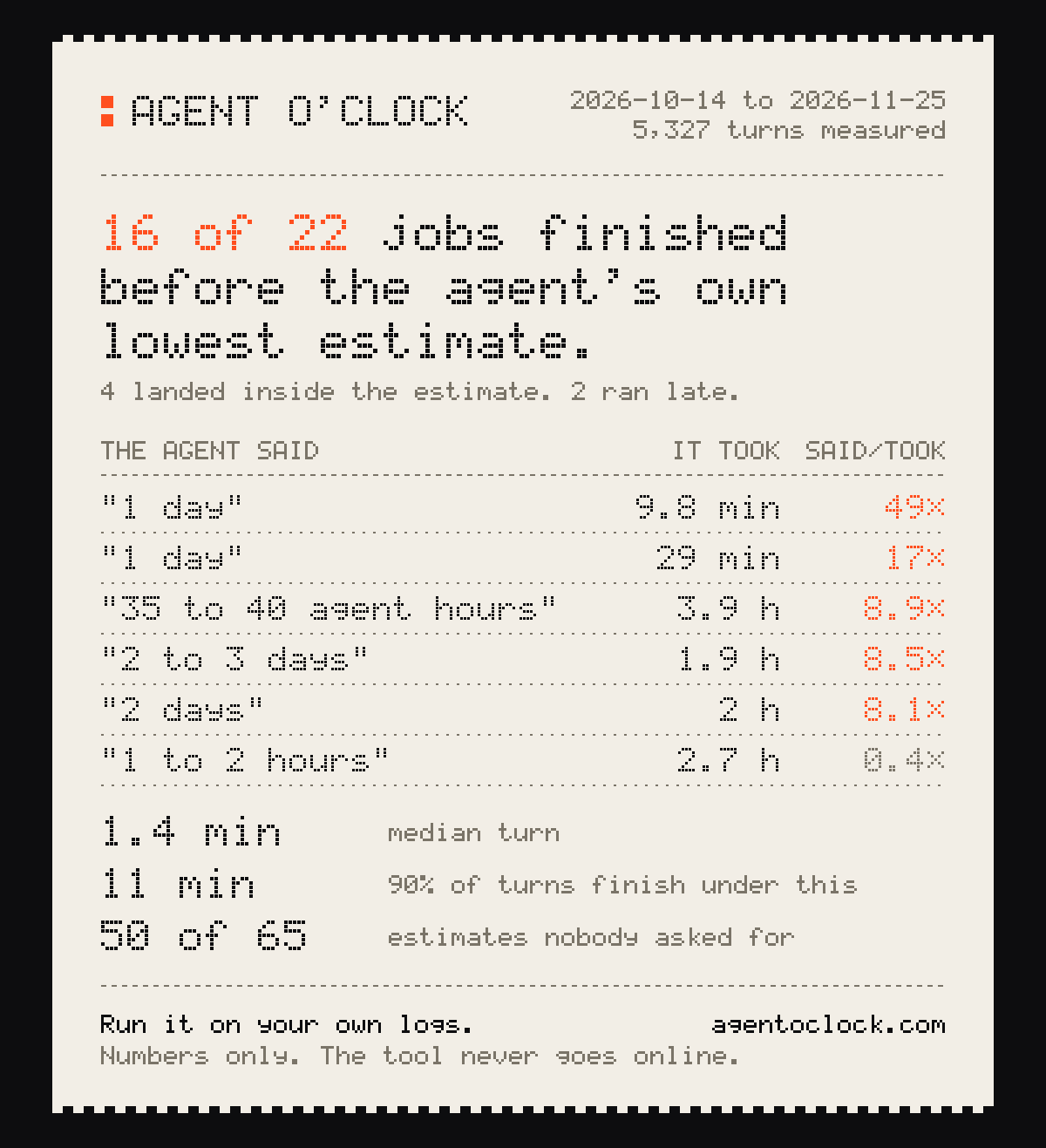
The receipt from six weeks of my logs: 16 of 22 finished jobs wrapped up before the agent’s own lowest estimate.
The real numbers are quieter than the viral punchlines on X. Across all 22 finished jobs, the median gap is 2.6x, and the full range runs from 0.4x to 49x.
The split by size shows where the drift lives:
- Estimates in hours were close: 1.5x median. Jobs sized at an hour or two (3 of 22) took 8 min to 2.7 h; 2 to 6 hours (8 of 22) took 23 min to 5.2 h.
- Estimates in days ran high: 5.7x median. A day (5 of 22) took 10 min to 3.8 h; 2 to 5 days (4 of 22) took 1.9 h to 18 h; 1 to 3 weeks (2 of 22) took 46 to 51 h.
“A 1-day test” took 10 minutes. “About one day of work” took 29 minutes. On the slow end, 2 of 22 ran late, down to 0.4x. Long runs were mostly waiting: one job waited 293 minutes for a human yes, and one worker stalled 12.5 hours overnight.
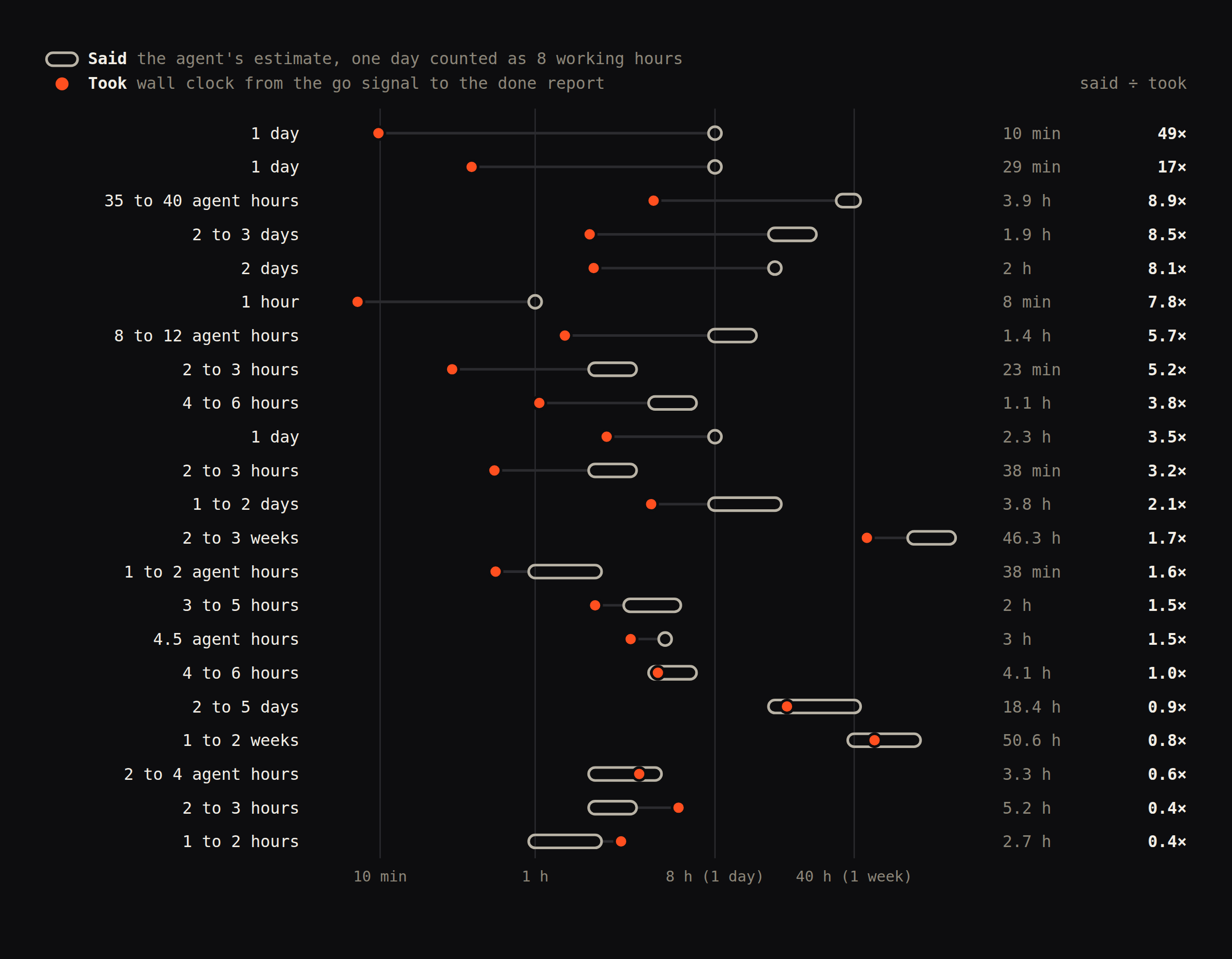
All 22 finished jobs on a log scale, plotting what the agent said against what the job took.
The same six weeks also show raw speed with no estimate involved. Across 8,502 runs in my orchestrator’s run table (one run is a turn from request to answer):
- Top-level agents (5,327 of 8,502 runs): 1.4 minutes at the median, 90% under 11 minutes, 99% under 42 minutes, and 0.4% over an hour.
- Subagents (3,175 of 8,502 runs): 6 minutes at the median, 90% under 43 minutes, and 99% under 2.9 hours.
An agent whose median turn takes 1.4 minutes sits down and quotes days.
Why a rule does not fix it
Telling the agent did not carry. I said it at least five times in six weeks, and the next session quoted days again.
Anthropic tried a rule too. Claude Code 2.0.43, in November 2025, added the line “Never suggest timelines” to its system prompt. The line is not in version 2.1.325, the one on my machine today. I do not know when it left, or which of my sessions ran with it.
Banning human units shifts the label and keeps the guess. One agent quoted “35 to 40 agent hours” for a job that took 3.9 hours.
Time-blindness is a missing sense, not a missing rule.
An agent has no clock and no record of its own speed. It learned what work costs from people who size work for people. A fixed multiplier fails too: across 22 finished jobs the gap spans 0.4x to 49x, so a static divisor misses both ends. The record has to come from your own logs.
What I built
I built Agent O’Clock to give coding agents that record. It is MIT-licensed at github.com/zouhall/agentoclock.
Paste one prompt into Claude Code or Codex:
Clone github.com/zouhall/agentoclock into ~/.agentoclock/src and follow its INSTALL.md.Your agent handles the rest. A speed pass reads timestamps from your Claude Code and Codex logs with no model needed. A claims pass finds past estimates, and your agent reads masked excerpts to mark real agent work and when it finished.
It prints a text receipt and a shareable PNG, then asks before changing any file. Say yes, and it adds a short record block to ~/.claude/CLAUDE.md and ~/.codex/AGENTS.md so every session starts with the agent’s real speed. agentoclock uninstall removes it cleanly.
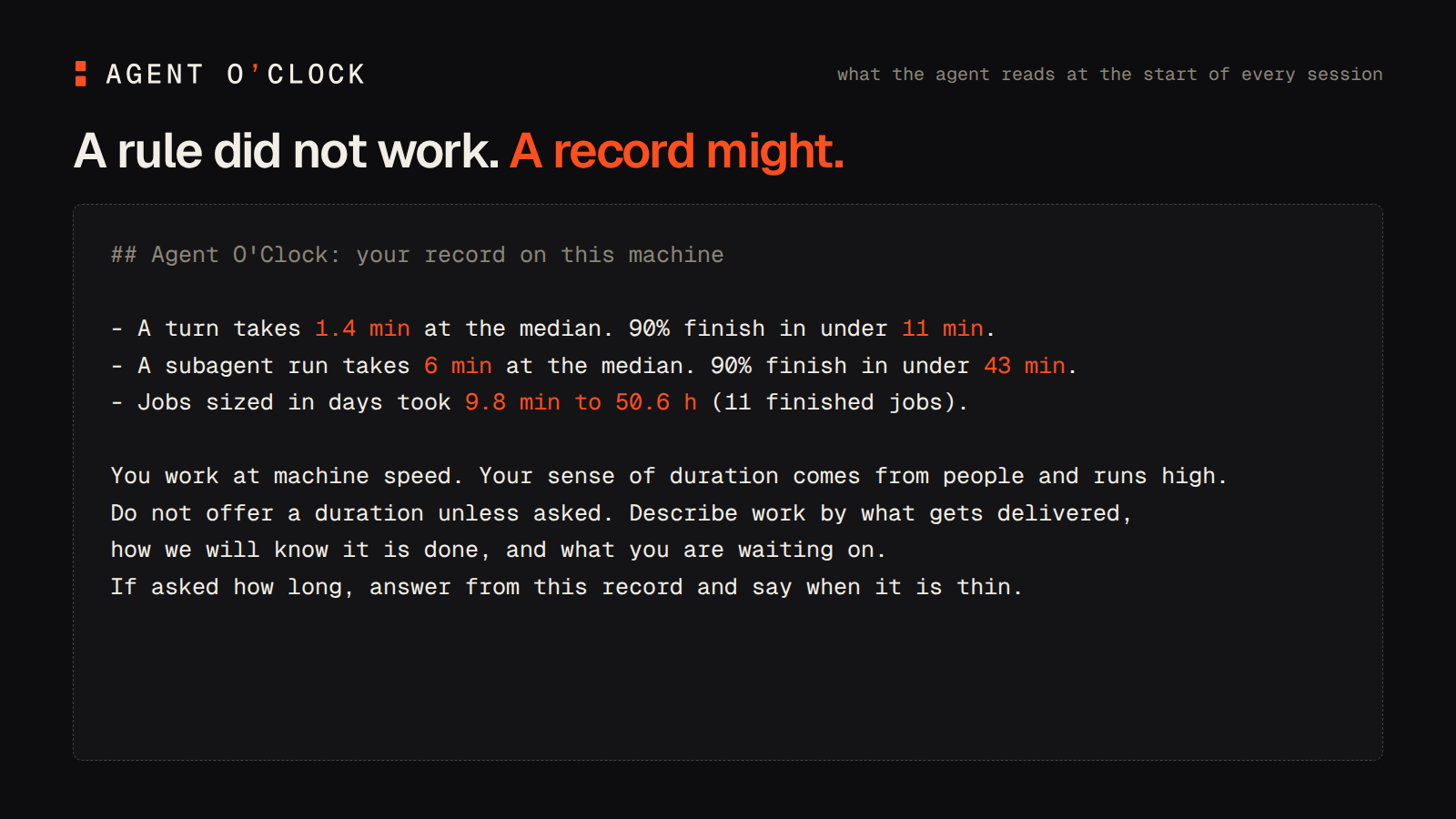
The record block Agent O’Clock writes into your instruction files, read at the start of every session.
It needs Python 3.9 or newer, has no dependencies, and makes no network calls. Only agentoclock case prints masked log text into your active session. record.json stores only numbers, fixed labels, and the short duration phrase, with no paths, project names, or message text.
Prior work
I am not first here. Martin Monperrus named the problem the “anthropocentric time bias” in Coding Agents Have Completely Wrong Sense of Time.
Two papers measured it in labs:
- Can LLMs Perceive Time? measured estimates 4 to 7 times too long on 68 tasks, and 5 to 10 times in agent settings.
- Your Agents Are Not Time Aware (235 tasks) and AgentTime (222 tasks) measured it on more than 200 tasks. On successful runs in the 235-task study, Fable 5 overestimated by 3.1x and GPT-5.6 Sol by 9.9x.
Other builders shipped clocks and estimators (claude-code-message-timestamps, timebox, realtime-est, ai-time-estimator). Agent O’Clock adds the look backward at real work from plain logs. All 65 jobs, 8,502 run times, and 51 posts sit in the repo.
What I do not know yet
I do not know yet whether the record changes behavior. Telling the agent did not.
To test it, run agentoclock again two weeks after install. It rescans your logs and counts how often your agent quoted days or weeks per 1,000 messages before and after.
The study also has clear limits:
- One operator, six weeks, 22 finished jobs. 17 of 22 ran on Claude Opus 5.5, so this ranks no models.
- Wall clock includes waits, and most people will have fewer than 22 finished pairs (the receipt leads with raw turn speed when pairs are thin).
- Claim checks are a model judgment, patterns are English only, the scanner cannot follow work across sessions, and version 0.1 supports Claude Code and Codex only.
If you run Claude Code or Codex, try the prompt at agentoclock.com or inspect the repo at github.com/zouhall/agentoclock. If you open an issue with your receipt, results that contradict mine are the most useful ones.